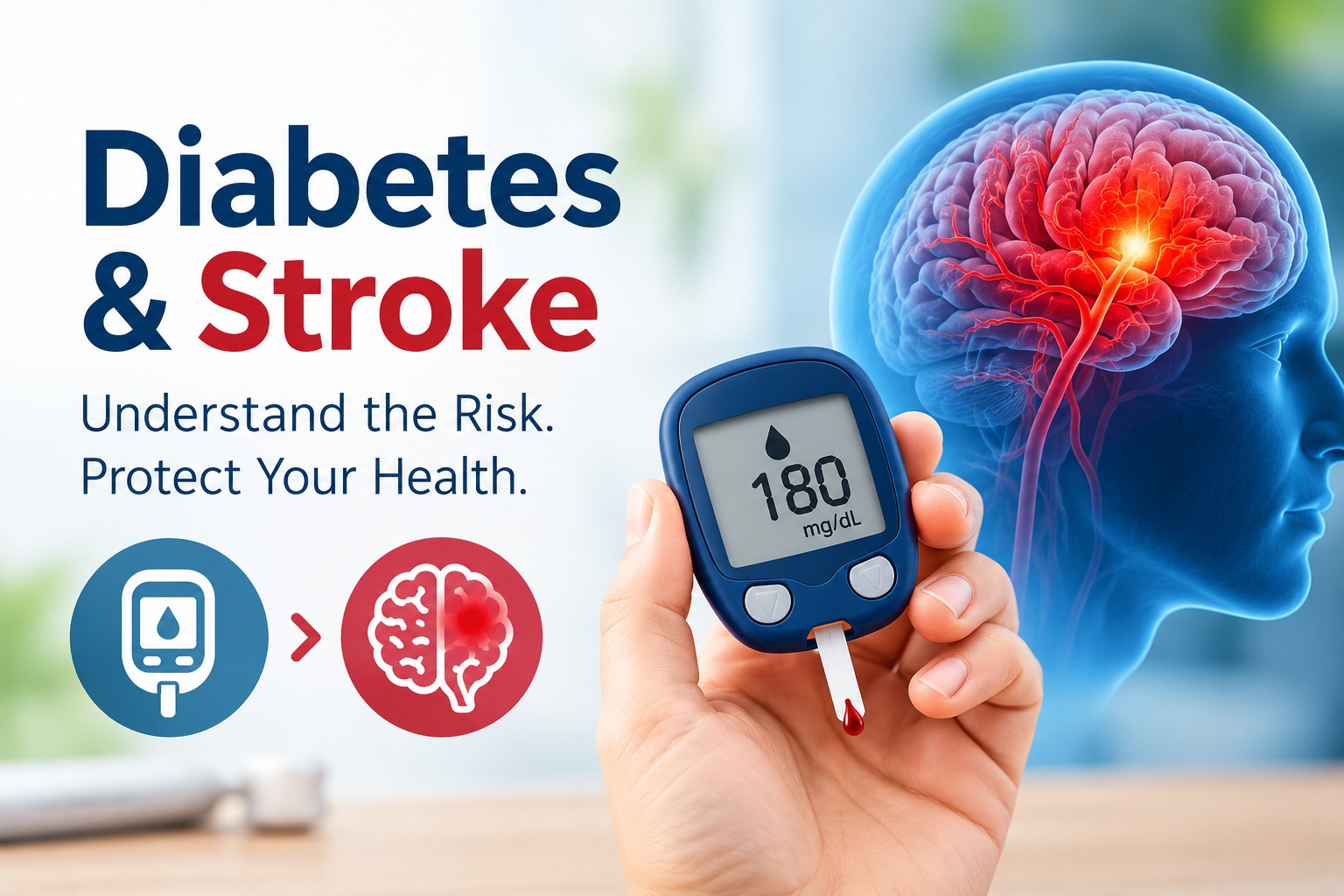
You take your medication and watch your sugar, yet the bigger picture can still feel unclear. Many people with type 2 diabetes never hear this part plainly: diabetes and stroke are closely linked. People with diabetes are twice as likely to have a stroke as people who do not have it. The encouraging part is that most of the drivers can be changed. This guide explains how high blood sugar harms the brain’s blood supply, which risk factors matter most, which warning signs need an emergency response, and which prevention steps make a real difference.
Quick Answer:- Type 2 diabetes raises stroke risk because long-term high blood sugar damages and narrows blood vessels, encourages clots, and usually comes with high blood pressure and cholesterol. People with diabetes are about twice as likely to have a stroke. You can lower that risk by keeping A1C near your target, controlling blood pressure and cholesterol, not smoking, staying active, and knowing the BE FAST warning signs.
What is the link between type 2 diabetes and stroke?
Type 2 diabetes is a long-term condition in which the body makes too little insulin or cannot use it properly, so glucose builds up in the blood. A stroke happens when blood flow to part of the brain is blocked or a vessel bursts, cutting off oxygen. The two are connected because persistently high glucose, together with related problems such as high blood pressure and abnormal cholesterol, damages the vessels that feed the brain and makes blockages far more likely.
How Does Diabetes Cause a Stroke?
Think of your blood vessels as plumbing that has to stay smooth, flexible and open. Sugar that runs high for years works against all three. Prolonged high blood sugar can stiffen blood vessels and let fat build up inside them. Excess glucose can also increase fatty deposits or clots that may lead to stroke.
Three routes to the brain
Diabetes doesn’t cause strokes in just one way. Clinicians usually describe three pathways:
- Large artery disease. High blood sugar, abnormal blood fats and insulin resistance speed up plaque buildup in the large arteries leading to the brain, and a ruptured plaque can trigger an ischemic stroke.
- Small vessel disease. Diabetes damages tiny vessels deep inside the brain, raising the risk of lacunar strokes, which are small but can still cause real disability and cognitive decline.
- Clots from the heart. Atrial fibrillation is more common in people with type 2 diabetes, and the clots it forms in the heart can travel to the brain.
Why type 2 diabetes stacks the odds
Insulin resistance rarely arrives alone. It often travels with belly fat, high blood pressure and abnormal cholesterol. Each one raises stroke risk by itself, and together they compound. That’s why heart disease and stroke are the two leading causes of death among adults with diabetes.
Summary: Diabetes harms the brain’s blood supply through plaque in large arteries, damage to tiny vessels, and clots from an irregular heartbeat. Blood pressure, cholesterol and weight multiply the effect.
Type 2 Diabetes Stroke Risk Factors
Blood sugar is only part of the story. Here are the factors worth knowing, with what to do about each.
| Risk factor | Why it matters | What to do |
|---|---|---|
| High or swinging blood sugar | Slowly damages vessel walls | Check A1C two to four times a year |
| High blood pressure | Strains and injures arteries | Home readings, medication if needed |
| Abnormal cholesterol | Feeds plaque buildup | Ask about a statin |
| Smoking or vaping | Narrows vessels, promotes clotting | Get quit support |
| Excess weight, especially around the waist | Worsens insulin resistance | Aim for steady, modest loss |
| Low physical activity | Raises sugar, weight and pressure | Build up to regular movement |
| Atrial fibrillation | Sends clots to the brain | Report palpitations, ask for an ECG |
| Longer diabetes duration, older age, kidney disease, family history | Cumulative vessel stress | Keep regular screening visits |
Prediabetes counts too. People with prediabetes are at higher risk of developing type 2 diabetes, heart disease and stroke.
What the numbers say
Large studies show that stroke risk climbs with poor glucose control. In an analysis of more than 850,000 people with type 2 diabetes, those with an average A1C of 10% or higher were 140% more likely to have a stroke than those at 6.75 to 6.99%. A Swedish observational study of about 270,000 people found A1C to be the strongest predictor of stroke, with risk rising steadily above 7%.
Diabetes also changes when and how strokes hit. People with diabetes tend to develop heart disease or have a stroke at an earlier age than those without it. One study found about 49% of people with diabetes were alive five years after a stroke, compared with about 55% of people without diabetes.
Why this matters in the UAE
The Gulf region carries a heavy load. Diabetes rates across the GCC countries, including the UAE, range from 8% to 22%. The IDF also estimates that 85 million people in the Middle East and North Africa region have diabetes, a figure expected to reach 163 million by 2050. Globally, an estimated 252 million adults with diabetes don’t know they have it. Undiagnosed diabetes quietly adds to stroke risk, so screening matters even when you feel fine.
Summary: Poor glucose control, high blood pressure, abnormal cholesterol, smoking and atrial fibrillation are the main stroke risk factors in type 2 diabetes. Higher A1C tracks with higher stroke risk, and many people in the region live with undiagnosed diabetes.
Stroke Warning Signs and BE FAST
A stroke is an emergency, whether or not you have diabetes. Cleveland Clinic Abu Dhabi’s health library lists these signs: sudden numbness or weakness in the face, arm or leg (especially on one side), trouble speaking or understanding, double or reduced vision, difficulty swallowing, dizziness or loss of balance, sudden paralysis, and a sudden, intense, unexplained headache.
The BE FAST checklist makes this easier to remember in the moment:
| Letter | What to check |
|---|---|
| Balance | Sudden dizziness or loss of coordination |
| Eyes | Sudden vision loss or double vision |
| Face | One side of the face droops when smiling |
| Arm | One arm drifts down when both are raised |
| Speech | Slurred, strange or confused speech |
| Time | Note when it started and call emergency services |
If you notice any of these signs, call 999 and get to hospital immediately. Time matters because the clot-busting drug tPA must be given within 4.5 hours of symptom onset.
One point specific to diabetes: very low blood sugar can look like a stroke. Paramedics check glucose for exactly that reason. Don’t try to sort it out yourself, and call first. Symptoms that fade within minutes, sometimes called a mini-stroke or TIA, still need urgent assessment because they often come before a full stroke.
Summary: Use BE FAST. If any sign appears suddenly, call 999 right away and note the time it started. Don’t wait to see whether it passes.
How to Lower Your Stroke Risk Step by Step
Prevention with type 2 diabetes is a set of habits and checks that reinforce each other. Here is a practical order to work through.
- Know your numbers. Get your A1C, blood pressure and cholesterol checked, then keep a simple log.
- Eat for your arteries. A diet rich in whole grains, fruit and vegetables, and low in added sugar and salt is a good starting point, with olive oil, legumes and omega-3-rich fish as heart-friendly choices. The American Stroke Association also suggests at least 14 grams of fiber for every 1,000 calories.
- Move most days. Aim for at least 150 minutes of moderate exercise a week. A brisk walk counts. Check with your doctor before starting anything intense.
- Lose a little weight if you carry extra. Lifestyle changes can produce a 3% to 5% weight loss, and the health benefits come when that loss is maintained.
- Stop smoking and vaping. This is one of the fastest ways to reduce vessel damage.
- Keep alcohol modest. The guidance is no more than one drink a day for women and two for men.
- Take preventive medication as prescribed. This can include blood pressure medicine, a statin, and in some people blood thinners for atrial fibrillation.
Numbers to know
| Measure | Commonly cited goal | Notes |
|---|---|---|
| A1C | Below 7% | Your doctor may set a different target for you |
| Blood pressure | Below 140/90 mm Hg for most people with diabetes | Some guidelines set a tighter target when it can be reached safely |
| Cholesterol | A moderate-intensity statin is recommended for ages 40 to 75 with LDL-C between 70 and 189 mg/dL | Overall risk decides for other ages |
Lifestyle changes versus medication
| Approach | What it does | Limits |
|---|---|---|
| Diet, activity, weight loss | Improves sugar, pressure, cholesterol and weight together | Needs long-term consistency |
| Statins | Lowers LDL and slows plaque growth | Needs monitoring, doesn’t replace lifestyle |
| Blood pressure medicines | Protects vessel walls | May need adjusting over time |
| GLP-1 receptor agonists | Help control blood sugar and weight and can lower stroke and heart disease risk | Prescription only, cost and side effects vary |
Never stop or change a medicine on your own. Talk to your clinician first.
Summary box: The strongest prevention plan combines regular checks, a fiber-rich diet, about 150 minutes of weekly activity, no tobacco, and the medicines your doctor recommends.
What Most People Misunderstand
“My sugar is fine, so I’m safe.” Not quite. Stroke risk in type 2 diabetes comes from several sources. Researchers are still studying why people with type 2 diabetes stay at higher risk of heart disease and stroke even after cholesterol is lowered. Good glucose control helps, but it doesn’t cancel out blood pressure or smoking.
“Lower A1C is always better.” Not always. Trial data suggest that pushing A1C to near-normal levels below 6.5% doesn’t significantly reduce stroke incidence. One large record review found no extra stroke benefit at average A1C levels below 5.7%. Aggressive targets can also raise the risk of low blood sugar, so a personal target beats a universal one.
“Strokes only happen to older people.” Diabetes often brings them earlier, as noted above.
Common mistakes
- Skipping blood pressure checks because the reading was fine once.
- Assuming a normal cholesterol result means a statin isn’t needed.
- Waiting to see whether symptoms pass, or driving yourself to hospital instead of calling emergency services.
- Treating diabetes as a sugar-only problem.
What experienced patients tend to do
They keep a small log of glucose and blood pressure readings, bring it to every appointment, ask directly about their stroke risk, and set phone reminders for medication and yearly checks.
Treatment and Recovery
Speed decides much of the outcome. Cleveland Clinic Abu Dhabi describes these options:
| Option | Purpose |
|---|---|
| Clot-busting medication (tPA) | Dissolves a clot in an ischemic stroke if given early |
| Carotid endarterectomy | Surgically removes plaque from the carotid artery |
| Carotid angioplasty and stenting | A less invasive option for some blocked arteries |
| Physical and occupational therapy | Rebuilds strength and everyday abilities |
Recovery varies widely. Some people have a small stroke and recover quickly, while others need rehabilitation, and recovery can take weeks, months or even years.
A quick note on limits: this article is general education. Targets, medicines and timing depend on your age, kidney function, other conditions and medication history, so let your care team set them.
People Also Ask
Can diabetes cause a stroke?
Yes. Long-term high blood sugar damages vessels and promotes clots, and diabetes roughly doubles stroke risk.
How does diabetes cause a stroke?
It stiffens and narrows arteries, harms tiny brain vessels, and raises the chance of heart-related clots.
What are the first signs of a stroke if you have diabetes?
The signs are the same: sudden face droop, arm weakness, speech trouble, vision loss, or loss of balance.
Which type of stroke is most linked to diabetes?
Mostly ischemic strokes, which are caused by a blockage.
Can you recover from a stroke with diabetes?
Many people do, though outcomes depend on stroke severity and how quickly treatment starts. Diabetes can make recovery harder.
Does losing weight lower stroke risk?
It can help indirectly by improving blood sugar, blood pressure and cholesterol. A 3% to 5% loss already brings health benefits.
When should I call emergency services?
Immediately, at the first sudden sign. In the UAE, call 999.
FAQ
What A1C level keeps stroke risk lowest?
Most guidelines aim for an A1C below 7% for adults with type 2 diabetes, and large studies show stroke risk rising steadily above that level. Lower isn’t automatically safer, though. Trials of very tight control haven’t shown clear stroke benefits, and pushing too hard can cause dangerous low blood sugar. Your doctor may set a looser or tighter goal based on your age, other conditions and history of hypoglycemia. Ask what your personal target is, and test A1C two to four times a year so you can see whether your plan is working.
Can I have a stroke even if my sugar is well controlled?
Yes. Blood sugar is only one piece of your risk. High blood pressure, abnormal cholesterol, smoking, atrial fibrillation, age and family history all count, and research shows that people with type 2 diabetes can stay at higher cardiovascular risk even after cholesterol is lowered. Good glucose control lowers your odds but doesn’t remove them. The safest approach is managing every factor together, knowing the BE FAST signs, and calling emergency services quickly if symptoms appear.
Do diabetes medicines help prevent stroke?
Some do. The American Stroke Association notes that a recent stroke prevention guideline supports GLP-1 receptor agonists for people with type 2 diabetes, because they help with blood sugar and weight and can lower stroke and heart disease risk. Statins and blood pressure medicines also reduce risk. Which medicine suits you depends on your kidney function, weight, heart history and side effects. Talk with your doctor about which combination makes sense, and don’t start or stop anything on your own.
Should I get checked if I only have prediabetes?
Yes. Prediabetes raises the chance of developing type 2 diabetes, heart disease and stroke, so it deserves attention rather than a wait-and-see approach. Ask for blood pressure, cholesterol and A1C testing, and start the same habits described above: fiber-rich food, regular movement, no tobacco and gradual weight loss. Catching problems at this stage gives you the widest choice of options and the best chance of avoiding both diabetes and its vascular damage.
Diabetes and stroke share a root problem: blood vessels worn down by years of high sugar, pressure and cholesterol. That is also what makes prevention realistic. You don’t need a perfect plan, just steady habits, regular checks, honest conversations with your doctor, and fast action when warning signs appear. If your numbers are unknown, book a check this month. If a sudden symptom shows up, call 999 before anything else. A few consistent choices today can protect your brain for years.
Key Takeaways
- People with diabetes are about twice as likely to have a stroke, and strokes tend to come earlier.
- High blood sugar damages large arteries, small brain vessels and raises heart-related clot risk.
- Blood pressure, cholesterol, smoking, weight and atrial fibrillation matter as much as glucose.
- Personal A1C targets beat one-size-fits-all goals; lower isn’t always safer.
- Use BE FAST and call 999 immediately at the first sudden sign.
- Prevention combines diet, about 150 minutes of weekly activity, no tobacco and prescribed medicines.
- Screening matters because many people have diabetes without knowing it.
في كليفلاند كلينك أبوظبي، نتعامل مع العلاقة بين السكري والسكتة الدماغية بنهج متكامل يجمع عدة تخصصات في مكان واحد على جزيرة الماريه. يضم المستشفى معهد الأعصاب ومعهد القلب والأوعية الدموية والصدر ومعهد التخصصات الطبية ومعهد التشخيص وقسم الطوارئ، ما يتيح لك الحصول على التقييم والفحوصات وخطة الوقاية والمتابعة دون تنقل بين أكثر من جهة. وسواء كنت تعيش مع السكري من النوع الثاني وترغب في خفض خطر الإصابة بالسكتة، أو لديك أعراض تستدعي الفحص، يساعدك فريقنا على فهم أرقامك وبناء خطة تناسب حالتك. للحجز والاستفسار، اتصل بالرقم 800 8 2223 (800 8 CCAD) من داخل الإمارات أو +971 2 659 0200 من خارجها، وزر موقعنا www.clevelandclinicabudhabi.ae. العنوان: كليفلاند كلينك أبوظبي، جزيرة الماريه، أبوظبي، الإمارات العربية المتحدة. يمكنك أيضًا البحث عن «كليفلاند كلينك أبوظبي» على خرائط جوجل عبر ملف النشاط التجاري الخاص بنا لمعرفة الموقع والاتجاهات وساعات العمل وتقييمات المرضى. وفي حالات الطوارئ أو عند ظهور علامات السكتة الدماغية، اتصل بالرقم 999 فورًا.